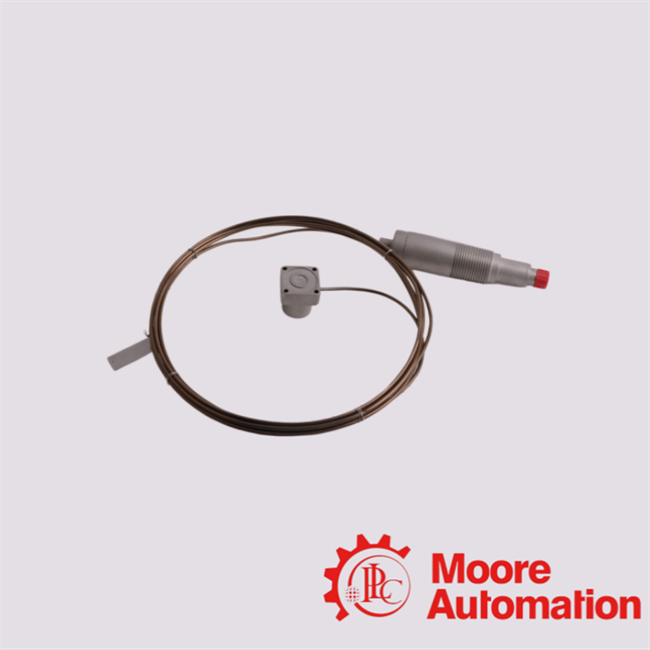
The 330750-40-05 Bently Nevada High Temperature Velomitor System is an advanced vibration monitoring solution engineered for extreme high-temperature industrial environments. This system is specifically designed to measure machinery casing and structural vibration velocity in applications where conventional vibration sensors cannot survive. It enables accurate condition monitoring on surfaces with temperatures up to +400 °C (+752°F).
The system separates the sensing element from signal conditioning electronics, allowing the electronics to be installed in a cooler zone while the sensing head operates directly in extreme heat environments.
Ensures safe operation in hazardous and explosive industrial environments.
The 330750-40-05 Bently Nevada High Temperature Velomitor System is ideal for:
The 330750-40-05 Bently Nevada High Temperature Velomitor System utilizes a segregated sensing architecture, where the sensing head is physically separated from signal conditioning electronics via a permanently attached hardline cable, allowing the sensing element to operate at temperatures up to +400°C (+752°F) while electronics remain in a cooler zone.
The system removes intermediate connectors entirely by using an integrated hardline cable design, thereby eliminating a major failure point commonly associated with vibration sensors operating under thermal cycling and mechanical stress.
The system provides direct velocity-proportional output (piezo-velocity sensing), enabling more accurate representation of casing vibration energy compared to acceleration-derived systems, especially in turbine and compressor housings where vibration transmission is critical.
The system supports a broad frequency response range of approximately 15 Hz to 2000 Hz (±3 dB), making it suitable for capturing both low-frequency mechanical faults and high-frequency vibration signatures in rotating machinery.
The system compensates for thermal stress effects using a controlled transient temperature sensitivity factor (~0.0762 mm/s/°C typical), reducing measurement drift caused by rapid temperature fluctuations.
| 330106-05-30-20-02-CN | 330105-02-12-15-12-CN | 330104-00-13-10-02-05 |
| 330106-05-30-15-02-CN | 330105-02-12-10-02-CN | 330104-00-13-10-02-00 |
| 330106-05-30-15-02-00 | 330105-02-12-10-02-05 | 330104-00-13-10-01-CN |
| 330106-05-30-10-02-CN | 330105-02-12-10-02-00 | 330104-00-12-10-02-05 |
| 330106-05-30-10-02-05 | 330105-02-12-05-02-05 | 330104-00-12-10-02-00 |
| 330106-05-30-10-02-00 | 330105-00-05-10-02-00 | 330104-00-11-10-02-05 |
| 330106-05-30-05-02-CN | 330104-19-25-10-11-05 | 330104-00-11-05-02-00 |
| 330106-05-30-05-02-00 | 330104-15-23-50-02-00 | 330104-00-10-10-02-CN |
| 330106-00-04-10-02-00 | 330104-15-23-10-02-00 | 330104-00-10-10-02-05 |
| 330105-02-12-50-02-00 | 330104-13-20-50-02-00 | 330104-00-10-10-02-00 |